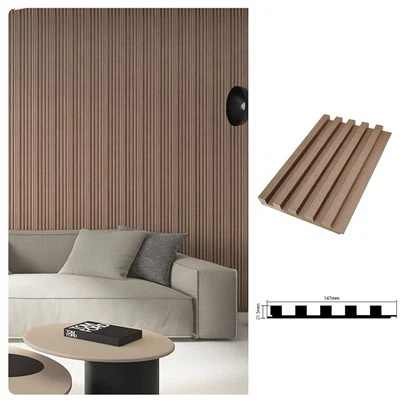
Hey guys, if you’ve ever scrolled through outdoor home improvement content or stopped to glance at a modern patio or commercial storefront, you’ve probably seen WPC wall panels—you know, that durable, wood-and-plastic combo that looks like real wood without the hassle of sealing or sanding every year. As someone who’s been supplying these bad boys for years, I get questions all the time: “What about sound? My house is near a busy street, or my office is next to a busy sidewalk—will these panels actually block noise?” That’s where STC comes in, and today I’m breaking down exactly what STC means for outdoor WPC wall panels, no jargon, no fancy math you don’t need. Outdoor WPC Wall Panel
First, let’s get one thing straight: STC stands for Sound Transmission Class. It’s a number that rates how well a material blocks sound from passing through it. The higher the STC, the more sound it stops. Think of it like a Netflix review for noise—if a material has an STC of 20, it’s basically like having a thin sheet of cardboard between you and the next room, or a busy yard. An STC of 35 is a big jump— that’s like a good wooden door, it softens loud noises, but you might still hear raised voices or loud music through. Get up to 50, and that’s solid, you can barely hear a TV from the next room, perfect for home offices or bedrooms. Anything above 55 is basically soundproofing, used for studios or concert halls, and that’s not what outdoor WPC panels are made for.
Now, why is STC for outdoor panels different from indoor stuff? Indoor walls are usually drywall, insulation, studs, all designed to trap sound. Outdoor WPC wall panels aren’t structural sound barriers—they’re cladding, right? Their main jobs are to resist rain, UV rays, mold, and hold up in wind, first and foremost. So their STC is never going to be as high as a brick wall or a specialized soundproofing panel. But that doesn’t mean they’re useless for noise control, especially if you’re pairing them with other elements of your outdoor space or building design.
Let’s get specific about what outdoor WPC panels actually test for when it comes to STC. Most suppliers, including ours, follow the ASTM E90 standard— that’s the big one for testing sound transmission across all building materials. We don’t just make up numbers to sound impressive; we send samples to third-party labs to get real, verified results. The STC for standard outdoor WPC wall panels, the ones you’d use for a patio, a garage wall, or a backyard shed, usually falls somewhere between 22 and 28. Wait, that might sound low to some of you, but hold up—let’s put that in perspective. A single layer of ½-inch drywall has an STC of about 28, and that’s a material people trust for indoor noise control. So our panels are matching that? Not bad, right?
But here’s the thing that most DIYers or first-time buyers don’t know: STC is for airborne sound—think traffic, voices, music. It doesn’t account for impact sound, like a ball bouncing off the wall or someone dropping a hammer, and it also doesn’t measure how sound reflects off the surface. WPC is a little more sound-absorbent than solid wood, actually—because it has that plastic mixed in, it’s not as hollow as a solid wood clapboard, so it doesn’t echo as much. That’s a big win for outdoor spaces, where you don’t want every conversation or lawnmower sound bouncing off your walls like an empty barrel.
Now, what if you need a higher STC for your outdoor project? Say you live on a busy main road, and your patio is right next to the sidewalk where cars zoom by all day, or you’re building an outdoor living space that has a TV or a sound system you don’t want leaking into the neighbor’s yard. Can you boost the STC of outdoor WPC panels? Absolutely, and we’ve got a few simple tricks that our regular clients swear by. First, don’t just mount WPC panels directly to the studs or the siding of your house. Add a layer of rigid foam insulation between the framing before you attach the WPC cladding. That extra layer adds another 5 to 8 STC points, easy. We use this trick for a lot of our commercial clients—like cafes with outdoor patios next to busy streets—because it’s cheap, easy to install, and doesn’t ruin the sleek look of the WPC panels.
Another hack: if you’re building a privacy wall from WPC panels, leave a 2 to 3 inch gap between the panel and whatever it’s mounted on. That creates an air gap, which is actually one of the best things for sound blocking. Air doesn’t conduct sound as well as solid material, so that gap can add another 3 to 5 STC points. And if you want to go all out, add a layer of mass-loaded vinyl (MLV) behind the WPC panels. MLV is that flexible, heavy material used for soundproofing, and it can bump STC up another 10 points or so. I’ve had a few residential clients use this on their backyard studios, and they swear by it—you can barely hear a lawnmower running at the end of the block.
Wait, let’s also talk about what STC outdoor WPC panels aren’t good for. If you’re looking for something to block the loud rumble of a highway or a train line, then WPC alone won’t cut it. You’d want something like a solid concrete wall or a specialized sound barrier fence for that. But for most everyday outdoor noise—neighbor’s dog barking, kids playing in the yard, the hum of a nearby road, even the sound of your own lawnmower or grill—WPC panels do a solid job. A lot of our clients are surprised when we tell them their standard STC of 25 is enough to make their patio feel quiet, even on a busy street.
Let me clear up a common myth too: a lot of people think thicker WPC panels mean higher STC. That’s partially true, but not as much as you’d think. Most standard WPC panels are either ½ inch or ¾ inch thick. The ¾ inch ones have an STC around 27, versus 22 for ½ inch, so that’s a small jump, but not a game-changer. The real difference comes down to what’s behind the panels, like insulation or air gaps, not the panel thickness itself. I’ve had clients ask us for “super soundproof” WPC panels, and honestly, that’s not really a thing—outdoor cladding is meant to be light, easy to install, and weather-resistant, not heavy like a sound barrier.
Also, it’s important to note that STC testing is done in a lab with perfect, controlled conditions. When you install panels in real life, little gaps around the edges, or if you leave a gap at the bottom for drainage (which you should, for outdoor panels!), can affect the actual STC you get. That’s why we always tell clients to caulk any gaps between panels when they install them, to keep as much sound in or out as possible. Don’t caulk the bottom gap, though—outdoor panels need that to drain water, so that gap is normal and will only lower STC by like 1 or 2 points, which is negligible for most projects.
Now, as a WPC panel supplier, I’ll be honest: we don’t market our panels as soundproofing, because that’s not what they are. But we do always list the STC for each of our panel lines, right on our product specs, so you know exactly what you’re getting. If you’re comparing WPC to other outdoor cladding materials, like vinyl or solid wood, how do they stack up? Vinyl siding usually has an STC around 20 to 25, solid wood clapboards are around 22 to 26, so WPC is right in that same range, sometimes a little higher because of the plastic component that dampens vibration. That’s a big selling point for a lot of people—you get the durability of WPC, no rotting or painting, plus the same or better noise control than traditional wood or vinyl.
Let me give you a real example, something I had last year. A client in Chicago reached out to us because he wanted to build an outdoor entertainment space off his back deck, which is right next to a busy side street with cars going 35 mph all day. He thought he’d have to go with a huge brick wall, which would be expensive and take up too much space. We recommended our standard ¾-inch WPC panels, paired with a layer of fiberglass insulation between the framing and the panels, and a 2-inch air gap. When he finished installing, he texted me a pic a week later saying it was night and day. He could hear his kids playing in the backyard, but the traffic noise was barely noticeable when he was hanging out on the patio. That’s exactly what we’re talking about.
Another example: a small coffee shop client in a busy downtown neighborhood, where their outdoor patio is steps away from a main road with delivery trucks and pedestrians yelling. They used our thicker, high-density WPC panels, added rigid foam insulation, and left a 3-inch gap between the panels and the building. The manager told us that now, when they play music on the patio, the neighbors don’t complain anymore, and they don’t have to yell to hear their staff during rush hour. That’s a huge win for a small business, no expensive soundproofing needed.
So, to wrap this up, what’s the takeaway on STC for outdoor WPC wall panels? First, STC is a rating that tells you how much sound a material blocks, higher is better, and outdoor WPC panels have an STC between 22 and 28 for standard models, verified by third-party testing. Second, you can easily boost that STC by adding insulation, creating an air gap, or using mass-loaded vinyl, if you need more noise control. Third, WPC panels are great for everyday outdoor noise, but they’re not going to block highway rumble or train noise—for that, you’ll need a specialized sound barrier. Fourth, WPC holds its own against other common outdoor cladding materials when it comes to sound blocking, plus it’s way easier to maintain, no painting, no sealing, no rotting, perfect for outdoor use.

If you’re planning an outdoor project—whether it’s a backyard patio, a privacy wall, a commercial patio, or a backyard studio—and you’re worried about noise, don’t hesitate to reach out. I can send you the exact STC numbers for our different panel lines, help you figure out what setup will work best for your noise concerns, or answer any other questions you have about WPC panels. We work with residential clients, contractors, and small businesses all the time, and we’re here to make sure you get the right product for your needs, no pushy sales talk, just straight answers. Hit us up to chat through your project and get a free quote, whatever that looks like for you.
Outdoor WPC Flooring References
- ASTM E90-21, Standard Test Method for Laboratory Measurement of Airborne Sound Transmission Loss of Building Partitions and Elements
- National Association of Home Builders (NAHB), 2022. "Sound Transmission Performance of Exterior Cladding Materials"
- WPC Manufacturers Association, 2023. "Technical Guide to Performance Metrics for Outdoor Wood-Plastic Composite Cladding"
Linyi Dongyuan International Trade Co., Ltd.
We’re well-known as one of the leading outdoor wpc wall panel manufacturers and suppliers in China, also support customized service. With abundant experience, we warmly welcome you to buy high quality outdoor wpc wall panel made in China here from our factory. Contact us for more details.
Address: No.A3-102, Mingzhu North Street, Xicheng, Lanshan District, Linyi City, Shandong Province, China
E-mail: Lydongyuan2024@163.com
WebSite: https://www.dy-wpcwood.com/
