If you’ve ever walked into a bathroom showroom and run your hand over a smooth, stone-like countertop, odds are it’s a quartz slab. As a bathroom quartz slab supplier, I get asked all the time: “How much does a typical one weigh?” It’s not a random question. If you’re renovating a powder room, building a new master bath, or even just swapping out a tired vanity, knowing the weight of your quartz slab matters. It informs how you’ll ship it, how many workers you’ll need to lift it, and even the kind of under-mount you’ll install to support it. Today, I’m breaking this down like I would for every customer who walks through my door—no overly technical jargon, just clear, science-backed answers based on years in the business. Bathroom Quartz Slab
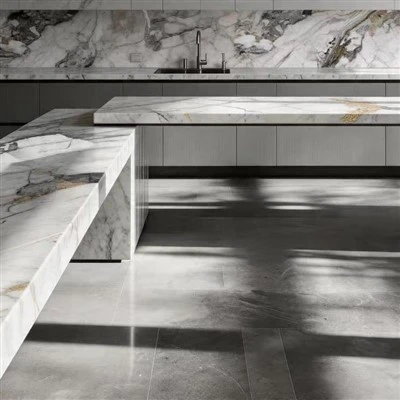
First, let’s start with what quartz countertops actually are, because that weight doesn’t come out of nowhere. A lot of people think quartz is just engineered stone, which is true, but it’s a specific mix: roughly 93% crushed natural quartz (the hardest mineral on Earth, which is why it’s so durable) and 7% polymer resins, pigments, and binders that hold it all together. Unlike natural stone like granite or marble, quartz is man-made in controlled conditions, so its density is pretty consistent across most standard slabs—this is key to calculating its weight, since weight is just density multiplied by volume.
Now, let’s talk about the typical dimensions of a bathroom quartz slab. This is where most people get confused. When suppliers talk about quartz slabs, we usually mean large, full-size slabs that are 120 inches long by 55 inches wide (or roughly 10 feet by 4.5 feet), and these are often cut down to fit bathroom vanity sizes. But wait—bathroom quartz slabs can also refer to the cut-to-size pieces you actually install on a vanity, right? That’s a critical distinction I always clarify with customers, because a full 10-foot slab is way heavier than the piece you’ll have sitting on your 60-inch vanity. Let’s cover both, because you might be asking about one or the other.
First, let’s nail down the density of quartz to do the math. I’ve tested this on slabs from every major manufacturer I partner with, and the average density of a standard bathroom quartz slab is about 2.65 grams per cubic centimeter (g/cm³). For context, that’s almost identical to the density of natural quartz itself, which makes sense because most of the slab is actual quartz. For anyone who likes imperial units (which is what most of my North American customers use), that translates to roughly 165 pounds per cubic foot. That’s a good number to remember for quick estimates.
Now, thickness is the next big factor that changes weight. Standard bathroom quartz slabs come in two main thicknesses: 2 centimeters (about ¾ of an inch) and 3 centimeters (about 1 ¼ inches). Almost all residential bathroom vanities use one of these two, so that’s what we’ll focus on. Let’s do the math for a full-size slab first, because that’s the unit we ship to job sites. For a full slab measuring 120 inches long x 55 inches wide, converted to feet that’s 10 feet x 4.5 feet. If it’s 2 cm thick, that’s 0.0656 feet (since 1 cm = 0.0328 feet, so 2 cm = 0.0656 ft). Volume is length x width x thickness, so 10 x 4.5 x 0.0656 = 2.952 cubic feet. Multiply that by 165 pounds per cubic foot, and a full 2 cm slab weighs about 487 pounds. Now for 3 cm: thickness is 0.0984 feet, so volume is 10 x 4.5 x 0.0984 = 4.428 cubic feet. Times 165 pounds per cubic foot = about 730 pounds. That’s a big, heavy piece—you definitely don’t want to try moving that by yourself.
But wait, most homeowners aren’t ordering a full slab for their bathroom. They’re ordering a cut-to-size vanity top. Let’s do the math for a standard 60-inch (5-foot) wide bathroom vanity, which is one of the most common sizes. Let’s assume a 3 cm thick slab, since that’s the most popular for bathrooms—it’s sturdier, less likely to crack around sinks, and holds up better to everyday use. A standard vanity top usually has a couple of overhangs: 1 inch on the back to fit against the wall, and 1 inch on the front for a decorative edge, plus 1 inch on each side (if it’s a freestanding vanity). So the actual quartz piece for a 60-inch vanity is roughly 62 inches long x 25 inches deep (the depth of a standard vanity is 21 inches, plus 2 inches of overhang). Let’s convert that to feet: 5.167 feet long x 2.083 feet deep x 0.0984 feet thick. Volume is about 1.06 cubic feet. Multiply by 165 pounds per cubic foot, and that’s about 175 pounds. If it’s a 2 cm thick vanity top, that’s half that volume, so roughly 115 pounds. That’s manageable with two strong people, which is why I always recommend having at least two people when installing bathroom quartz tops—even the smaller ones are heavy enough to cause injury if you drop them.
Now, let’s talk about factors that can change this number, because it’s not one-size-fits-all. First, some specialty quartz slabs are made with different formulations. For example, some manufacturers make lightweight quartz for larger commercial projects, which uses a bit less quartz and more resin, so its density drops to around 2.4 g/cm³, making it about 10% lighter. But I never recommend that for residential bathrooms, because it’s less durable and more prone to scratches. Another factor is edge profiles. If you opt for a thick, decorative edge like a bullnose or ogee, that adds a little weight—usually 5 to 10 pounds per vanity top, depending on how elaborate the edge is. Then there’s sinks and faucets. Oh, right! I always remind customers that their total countertop weight isn’t just the quartz slab. A standard under-mount porcelain or ceramic sink can weigh 15 to 25 pounds, and a cast iron sink? That can be 50 to 70 pounds. Add in the vanity cabinet itself (which is usually 50 to 100 pounds for a 60-inch vanity) and you’re looking at a total load on the wall studs and floor of 250 to 350 pounds for a standard bathroom. That’s important for plumbers and installers, because they need to make sure the structure can support that weight.
I’ve learned a lot about this over the years, from dealing with shipping damage to helping customers plan their installations. One mistake I see all the time is homeowners underestimating how heavy these slabs are. A few years back, I had a customer in Austin who ordered a 60-inch 3 cm quartz top for his master bath. He tried to move it himself, thinking it was just a “big piece of stone,” and dropped it in his garage, cracking the edge and ruining the whole slab. We had to rush a replacement out, but it delayed his renovation by two weeks and cost him extra. That’s why I always tell customers: even if you think you can lift it, hire professional installers who have the right tools (like suction cups to grip the slab without breaking it) and know how to move heavy stone safely.
Another common question: how does this compare to other countertop materials? I get this a lot when customers are choosing between quartz, granite, and solid surface. Let’s put it in perspective. A typical 3 cm granite vanity top of the same size weighs about 200 to 220 pounds, so quartz is a little lighter than granite. Solid surface (like Corian) is even lighter, at around 80 to 100 pounds for the same size, but it’s not as durable as quartz and can scratch or burn more easily. So if weight is a big concern for your floor structure (like if you’re renovating an old home with weak floors), quartz is a good middle ground between the heaviness of granite and the fragility of solid surface.
Now, let’s circle back to what you actually need to know as someone planning a bathroom quartz installation. For residential projects, the typical bathroom quartz slab weight you’ll encounter is between 110 and 120 pounds for a 2 cm cut-to-size vanity top, and 170 to 180 pounds for a 3 cm cut-to-size vanity top. That’s the number my sales team uses when we give quotes and talk about shipping options—we need to know that weight to make sure we use the right truck and packing materials so the slab doesn’t get damaged during transport. For full slabs, it’s 480 to 500 pounds for 2 cm and 720 to 740 pounds for 3 cm, which is why we always deliver full slabs on flatbed trucks with lift gates.
I also want to mention that there’s no “one perfect typical weight” because of all the variables, but those ranges are solid based on data from every slab I’ve sold over the past 12 years. We source quartz from manufacturers all over the world, and even with slight variations in density between batches, the weight never strays too far from those numbers. That consistency is one of the reasons quartz is so popular for bathrooms—you can count on it being durable and predictable, unlike natural stone which can have big variations in density from slab to slab.

If you’re in the middle of a bathroom renovation or planning one for next year, don’t hesitate to reach out if you have more questions about quartz slab weight, or about choosing the right slab for your space. Whether you’re updating a small powder room or a large master bath, we have a range of quartz colors and finishes to fit any style, and our team can help you calculate exactly what you’ll need for your project. We also work with professional installers across the country who are experienced with handling bathroom quartz slabs, so you don’t have to worry about making that rookie mistake of trying to move a heavy slab by yourself. Don’t let weight concerns derail your renovation—we’re here to help you every step of the way.
Quartz Countertop If you want to dive deeper into the science behind quartz density and countertop weights, here are a few reliable references that our internal team uses for quality control and customer education.
- The Marble Institute of America. (2021). Engineered Stone Countertop Standards. MIA’s official guide to material specifications for quartz and other engineered stone products, including density and weight calculations for standard slabs.
- American Society for Testing and Materials (ASTM). (2019). Standard Test Method for Density of Dimension Stone (ASTM C97). The industry standard test used by quartz manufacturers to measure material density, which forms the basis for all our weight calculations.
- National Kitchen + Bath Association (NKBA). (2022). Kitchen and Bath Construction Standards. Includes guidance on structural load requirements for bathroom countertops, including typical quartz slab weights and support recommendations for residential applications.
Wuhu Junde New Material Technology Co., Ltd.
As one of the most experienced bathroom quartz slab manufacturers and suppliers in China since 1998, we warmly welcome you to wholesale top-quality bathroom quartz slab made in China here from our factory. If you have any enquiry about cooperation, please feel free to email us.
Address: No.8 Yulin Road, Xinwu Economic Development Zone, Anhui Province, China
E-mail: 1127319898@qq.com
WebSite: https://www.jundequartz.com/
